AI Developments of the Week: India's Open Foundation Models, DeepSeek's Inference Stack, and the Data Center Compute Squeeze
A technical digest of new models, inference tooling, enterprise coding-assistant policy and AI infrastructure for the week of November 2–8, 2026.
Compiled from live news data by NewzAI · November 8, 2026
This Week at a Glance
Three open and on-device models shipped from India, enterprises tightened who gets AI coding assistants, and the compute buildout that feeds every model hit a rough patch. We also revisit DeepSeek's open-sourced inference engine, which landed in late October but is the most reusable engineering release of the past month.
EKA-1, Dhīr 2B and Dhīr 5B: Three Open Models from India
On Tuesday, November 3, the IndiaAI Mission released EKA-1, built by Soket Labs, and Dhīr 2B and Dhīr 5B, built by ZenteiQ. According to The Hindu, EKA-1 has 26.3 billion parameters and was trained on about 7.5 trillion tokens. It covers all 22 scheduled Indian languages plus English, and Soket describes it as an open, sparse hybrid language model aimed at math, code, reasoning and agentic use. Read on NewzAI →

Image credit: The Hindu / Reuters
The deployment story matters more than the parameter count. Per the report, EKA-1 can run some inference locally on a smartphone without mobile data or WiFi. Dhīr 2B and 5B are open-source, support English and 10 Indian languages, and ZenteiQ says they run on GPUs and TPUs and can be deployed on-device or as secure on-premise assistants. For developers building document-grounded retrieval in low-connectivity or data-sensitive settings, small multilingual open weights are the practical building block.
The government said subsidised national compute and research support enabled the work, and that platforms such as AIKosh could make the models available to researchers and students.
DeepSeek Open-Sources Its Inference Stack, DeepInfer
Published October 20 but still the week's best reading for inference engineers: DeepSeek released DeepInfer under the Apache License 2.0. Per Quartz, citing the repository and Bloomberg, it supports DeepSeek-V4.1-Flash on Nvidia SM100 GPUs and Huawei Ascend 950 NPUs. Read on NewzAI →
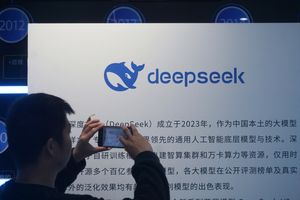
Image credit: Quartz / Getty Images
The feature list reads like a production serving checklist:
- Optimized kernels, including custom TileLang kernels, plus parallelism methods for attention and mixture-of-experts layers.
- A speculative-style decoding method that uses draft tokens and confidence estimates to schedule verification.
- Asynchronous scheduling that overlaps CPU batch scheduling with device execution.
- Batch-invariant inference and deterministic sampling (Nvidia hardware only), plus structured outputs.
The caveats: this is offline inference only. You must supply your own KV cache system, prefill/decode disaggregation and data-parallel load balancing. It needs Linux, GCC 13+, Python 3.12 and CUDA 13 or CANN 9.2. DeepSeek says it was built primarily on vLLM with inspiration from SGLang and TensorRT-LLM, and Bloomberg notes that no outside party has yet benchmarked its efficiency gains.
Goldman Narrows Access to AI Coding Tools
Per Bloomberg, as reported by The Times of India, Goldman Sachs has limited tools such as Anthropic's Claude Code and Microsoft's GitHub to engineers, with strats exempt, under guidance updated in October. A spokesperson said the tools go to "those who are best suited to leverage them" once a trial period ends. The bank cited productivity and risk, and it already runs an in-house assistant combining models from OpenAI, Anthropic and Alphabet. Read on NewzAI →
For platform teams the takeaway is role-based entitlement: JPMorgan said in July it wanted employees to match models to tasks so the priciest option isn't used for something as basic as summarising a report. Expect model routing and per-role access policies to become standard enterprise AI plumbing.
The Compute Squeeze: Capex, Chips and Siting
Capital Economics expects hyperscaler spending to double to around $800 billion in 2026 and reach $1 trillion in 2027, while analysts quoted by CBS News warn that slower or costlier data center development would ripple through growth. Read on NewzAI →

Image credit: CBS News / Getty Images
The market impact was immediate: Nvidia fell 3% and CoreWeave about 10% on Wednesday, with Samsung and SK Hynix pressured in Asia, per Quartz. Wells Fargo estimates Texas holds 27% of planned U.S. data center gigawatts, which shows how concentrated siting risk is. Read on NewzAI →
OpenAI CFO Sarah Friar said the company will keep raising capital and building. OpenAI's published compact commits it to pay the full cost of the electricity and infrastructure it uses and to publish site-level water and electricity use. Quartz also reports that developers had cancelled at least $260 billion of planned U.S. projects as of mid-October. Read on NewzAI →
Altman's "Self-Replicating Data Center" Idea
In an interview published October 29, Sam Altman said, in ITmedia Business Online's Japanese translation, that little is said about data centers that replicate themselves. He argued that recursive self-improvement should extend beyond models improving models to the physical stack: OpenAI is developing its own semiconductors and plans to use robots to build data centers at scale. This is a vision, not a product, and no timeline was confirmed in the article. Read on NewzAI →
The Bigger Picture
Two opposite pressures are converging. Models are shrinking and opening up, with EKA-1 and Dhīr targeting phones and on-premise boxes, while serving-stack work like DeepInfer chases lower cost per token. Meanwhile the supply of data center capacity looks less certain. Efficiency work stops being optional when capacity is scarce.
What to Watch
- Independent benchmarks of EKA-1, Dhīr and DeepInfer; none were cited in the reports we reviewed.
- Whether other labs publish their serving stacks after DeepSeek's release.
- More enterprises adopting role-based access to coding assistants.
- Cancelled or delayed data center projects and their effect on GPU demand.
Follow This Story on NewzAI
NewzAI tracks breaking news in real time — summarised from multiple sources so you get the full picture, not just a headline.
IndiaAI Mission releases EKA-1, Dhīr 2B and Dhīr 5B →
DeepSeek is open-sourcing the software it uses to run its AI models at scale →
Why thousands of Goldman Sachs workers can no longer use Claude Code, GitHub →
Data centers are unpopular — and a key motor of economic growth →