The State of Japan-India Cooperation on Bullet Trains
India's first bullet train is 80% built and Tokyo just called it a "flagship project." A Japanese rail engineer watching from Delhi tells a more complicated story about how it got there.
Compiled from live news data by NewzAI · July 16, 2026
Two visits, two very different tones
When Japanese Prime Minister Sanae Takaichi met Indian Prime Minister Narendra Modi in Delhi on July 2, the two leaders reaffirmed the Mumbai-Ahmedabad High Speed Rail (MAHSR) corridor as a "flagship project" between the two countries in their joint statement, with Japan pledging support for India's goal of a partial opening in 2027 using domestically produced train sets. Read on NewzAI →
Days later, a Japanese rail engineer based in Delhi — writing for Toyo Keizai, unconnected professionally to the project — published a more measured account of the same visit, framed around what he called the project's slow, uneven progress rather than diplomatic milestones. Between those two accounts sits the real state of the project: genuine engineering progress, alongside land, environmental and cost pressures that a joint statement doesn't capture. Read on NewzAI →
What the project actually is
MAHSR is India's first dedicated bullet train corridor: 508 km, 12 stations, running on standard-gauge (1,435 mm) track independent of India's broad-gauge network, at an operational speed of 320 km/h. It is being built with Japanese Shinkansen technology and financed substantially through a yen loan. The foundation stone was laid at Sabarmati in September 2017, with an original target opening of 2023 — a date that, as the Toyo Keizai piece notes, everyone involved already understood to be unrealistic at the time. Read on NewzAI →
India's case: real, visible progress
On the ground, the numbers back up India's optimism. Railway Minister Ashwini Vaishnaw says construction has crossed 80%, with the first operational stretch — Surat to Bilimora — targeted for August 15, 2027, followed in phases by Vapi-Surat, Vapi-Ahmedabad, Ahmedabad-Thane and finally Ahmedabad-Mumbai. Read on NewzAI →
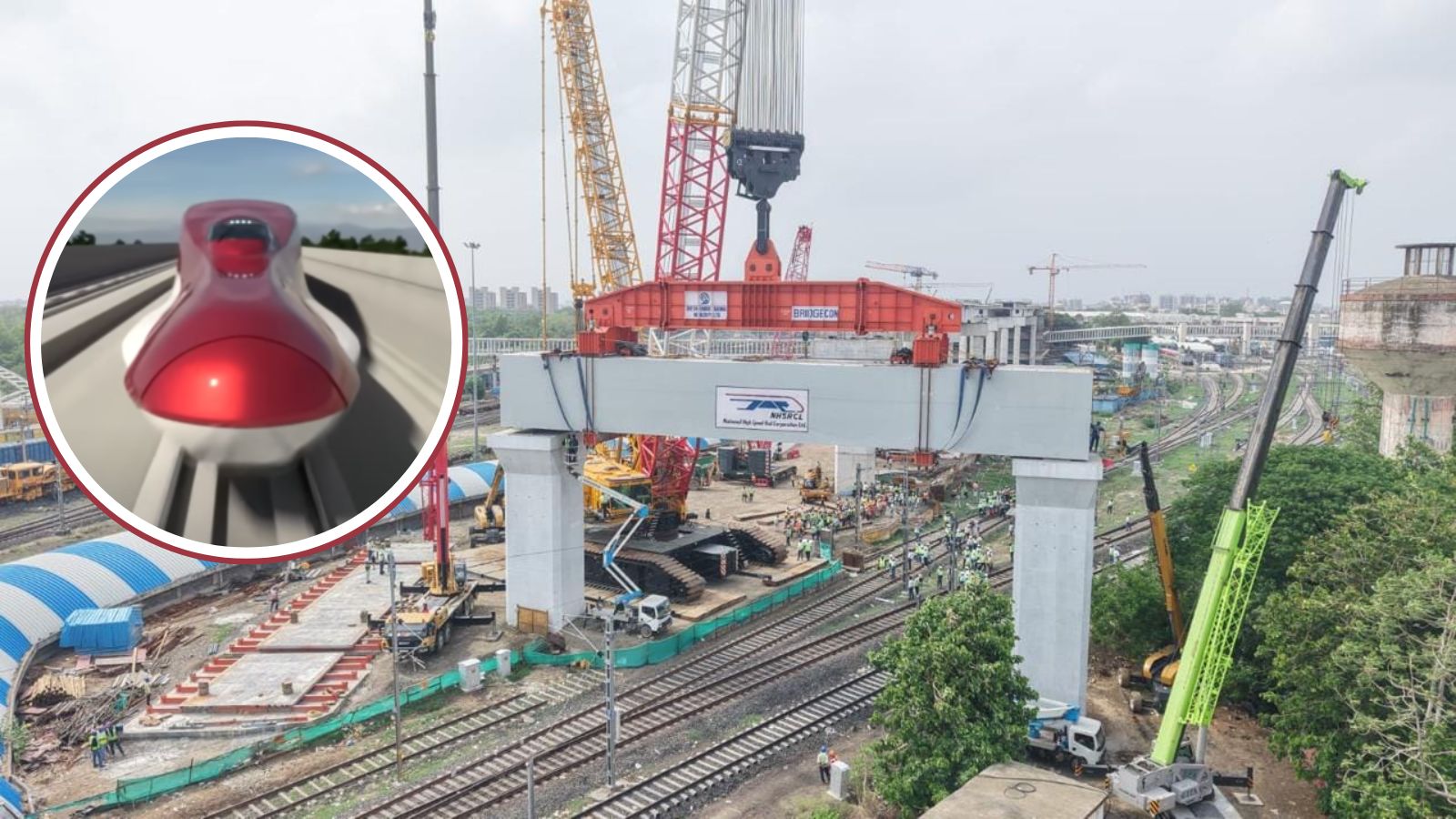
Image credit: The Indian Express
Engineering milestones have piled up through 2026: India's largest rail tunnel-boring machine began excavating a 6-km tunnel under dense Mumbai infrastructure in July; NHSRCL launched 13 heavy precast portal beams at Ahmedabad, including a 1,640-tonne beam — among the largest of its kind used on the corridor; and in June, the third mountain tunnel breakthrough in Maharashtra was completed, with all three tunnels between Vapi and Boisar now excavated. Foundational work is complete at 8 of the 12 stations. Read on NewzAI →
India is already planning beyond MAHSR: seven additional high-speed corridors covering nearly 4,000 km — including Delhi-Varanasi, Chennai-Bengaluru and a Hyderabad-centred triangle to Pune, Chennai and Bengaluru — are proposed at a combined investment of roughly ₹16 lakh crore, with officials framing MAHSR as the project that builds the expertise for all of them. Read on NewzAI →
The Japanese engineer's more cautious account

Image credit: Toyo Keizai Online
The Toyo Keizai piece, written by a Japanese railway engineer who works as a metro rolling-stock consultant in Delhi and attended the 2017 groundbreaking, doesn't dispute the progress — but it frames the last nine years differently. He notes that land acquisition was difficult even before a change of government in Maharashtra complicated it further, and that civil engineering work not specific to high-speed rail was opened up to Indian contractors to control overall costs, which limited Japan's direct involvement in that part of the build. The parts of the project that require genuine Shinkansen technology — track structure and electrification — are more advanced, he writes, but work on rolling stock and signalling/communications systems, arguably the technological core of a bullet train, has "only just begun." Read on NewzAI →
It's a notably different register from the joint statement signed the same week — a reminder that "flagship project" and "on track" can describe the same set of facts very differently depending on who's doing the describing.
Why Tokyo wants this to succeed
The bullet train is one piece of a much larger bet Japan is making on India. Takaichi's trip came at a moment of open friction with Beijing: after her remarks last November on a possible Taiwan contingency, which China called interference in its internal affairs, Beijing responded with export controls on Japanese firms tied to dual-use technology, diplomatic freezes and travel warnings. India — a fellow member of the Quad alongside the U.S. and Australia — gives Japan a way to visibly build "alternative partnerships" rather than simply protest China's measures. Read on NewzAI →
That framing showed up directly in the summit's structure: the two leaders issued a separate "Economic Security Joint Declaration" built around five priority areas — critical minerals, semiconductors, information and communications technology, pharmaceuticals and clean energy — explicitly citing concern over China's tightening rare-earth export controls. India holds the world's third-largest rare earth reserves at roughly 6.9 million tonnes, behind China and Brazil, yet mines less than 1% of global output and has relied heavily on cheap Chinese imports; after China's April export restrictions disrupted Indian industry, New Delhi approved a roughly ¥125 billion plan in November to boost domestic production. Japan and India were set to sign a memorandum on mineral-exploration technical cooperation at the summit. Read on NewzAI →
The bullet train sits inside a far bigger wave of capital: the Japan-India Economic Forum held alongside the summit produced 129 cooperation agreements between more than 150 Japanese and 80 Indian companies, worth roughly ¥2 trillion on the Japanese side alone — spanning Suzuki's expanded biogas production (part of a push toward 1,000 biogas plants and 2.5 million CNG vehicles across India), a 400,000-tonne-a-year green ammonia venture between IHI and a major Indian renewable energy firm, and a government-to-government memorandum on EV battery supply chains. Separately, Japan's development bank JBIC and Sumitomo Mitsui Banking Corporation agreed to lend up to ¥80 billion for India's power grid — the first project under "Power Asia," a regional energy framework Takaichi herself proposed, aimed at cutting Middle East energy dependence. Tokyo and Delhi have set a target of ¥10 trillion in Japanese private investment into India; an earlier, separate ¥5 trillion public-private finance goal set in 2022 was hit three years early. Read on NewzAI →
There's a domestic angle too: Takaichi made the trip as the Diet's session neared its July 17 close, with opposition parties accusing her of dodging committee hearings at home. Her government's economic blueprint calls for more than ¥370 trillion in public and private investment through fiscal 2040 across AI, semiconductors, shipbuilding, space and energy — and a high-profile, security-framed win in India helps her make the case that the strategy is working, even as she faces separate pressure at home over the Bank of Japan, a weak yen and fiscal credibility. Read on NewzAI →
There's also a reputational stake beyond India entirely. Australia has just moved its long-discussed east-coast high-speed rail plan into a real construction-preparation phase, starting with a roughly 191-km Sydney-Newcastle stretch expected to cut travel time from two hours to one and generate close to 100,000 jobs. Central Japan Railway (JR Central) has already opened a Sydney office, and Japan is pitching the Shinkansen's zero-passenger-fatality safety record and earthquake-triggered automatic braking system — relevant to a region with its own history of major quakes — as a competitive edge, with technology transfer envisioned if Australia picks the Shinkansen system. How MAHSR turns out is being watched, in other words, as a preview of Japan's broader rail-export credibility. Read on NewzAI →
The setbacks India's coverage doesn't skip over
Indian outlets have also reported the friction points as they happen. On July 15, a temporary construction bridge at Diva in Thane was washed away in heavy rain — officials said no one was on it at the time and that it was not part of the permanent rail infrastructure, and maintained the project timeline was unaffected. Read on NewzAI →
Image credit: News18
The same week, the Bombay High Court heard a state petition seeking permission to fell 847 mangroves in Palghar for a transmission line linked to the corridor. Acting Chief Justice Ravindra Ghuge warned of Mumbai's shrinking green cover and urged compensatory afforestation. It isn't an isolated request: the state Tree Authority cleared felling of more than 5,000 trees across Palghar and Thane last year for the bullet train and an adjoining expressway, and a Mangrove Society of India report found the corridor's 155-km Maharashtra stretch directly affects eleven mangrove species and habitat for over 170 bird species. Officials have promised compensatory tree planting each time, though where that planting will actually happen has drawn criticism as unclear. Read on NewzAI →
What to watch
The clearest test of the cooperation is now dated: August 15, 2027, when the Surat-Bilimora stretch is meant to open. Between now and then, watch three things — whether land and environmental clearances keep pace with civil works, how quickly rolling stock and signalling actually progress given the Japanese engineer's account that this core technology work has barely started, and whether the cost-driven decision to open non-specialised civil work to Indian contractors expands further into areas Japan originally expected to lead. How those three resolve will say more about the state of the partnership than any joint statement.
Follow This Story on NewzAI
NewzAI tracks breaking news in real time — summarised from multiple sources so you get the full picture, not just a headline.
Japan and India reaffirm the bullet train as a "flagship project" →
A Japanese rail engineer's on-the-ground account from Delhi →
Ashwini Vaishnaw sets an August 2027 timeline →
Inside the ¥2 trillion in deals signed alongside the summit →