SpaceX IPO: The $75 Billion Raise, Musk's Mars Bonus, and the Risks Wall Street Isn't Talking About
SpaceX filed its S-1 on May 20. The target: $1.75 trillion on Nasdaq. The pitch: Starlink's cash engine, xAI's future, and a founder who controls 85% of the votes. Here is what the prospectus actually says.
Compiled from live news data by NewzAI · May 28, 2026
यह लेख हिन्दी में भी उपलब्ध है — हिन्दी में पढ़ें →
The Ask: $75 Billion. The Record: Already Broken on Paper.
On May 20, 2026, SpaceX filed its Form S-1 with the US Securities and Exchange Commission — the first public look at the company's finances in its 24-year history. The terms are not subtle. SpaceX is targeting a listing on the Nasdaq under ticker SPCX, seeking to raise a minimum of $75 billion at a valuation of $1.75 trillion to $2 trillion, with a debut potentially as early as June 11–12.
For context: Saudi Aramco's 2019 IPO — previously the largest in history — raised $29.4 billion at a $1.7 trillion valuation. SpaceX is targeting more than twice that raise, at a higher valuation. If it lands anywhere near its target, it will be the largest public offering in the history of capital markets. Read on NewzAI →
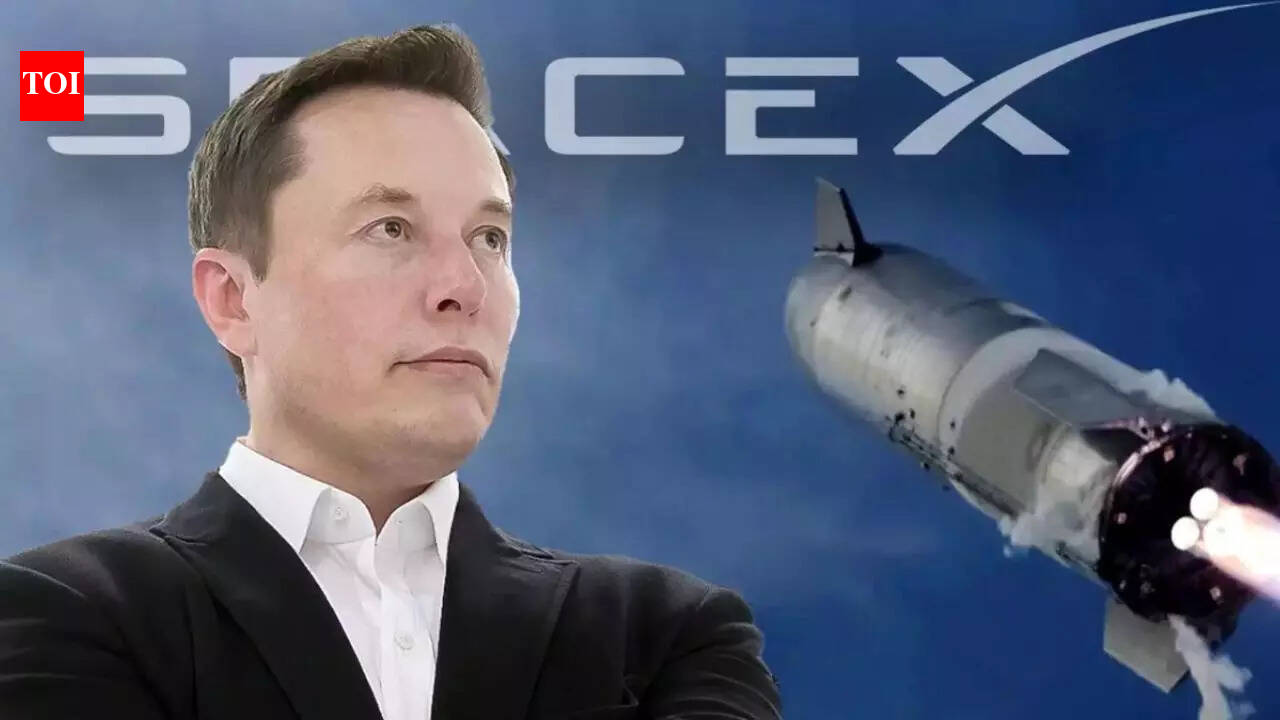
Image credit: Times of India
What the S-1 Actually Says: Growth, Losses, and a Burning AI Bet
SpaceX generated $18.7 billion in revenue in 2025, up 33% year-over-year from an estimated $14.06 billion in 2024. That is genuine hypergrowth for a company at this scale. The problem is on the other side of the ledger.
Despite surging revenues, SpaceX posted a net loss of $4.94 billion for 2025 and an operating loss of $2.6 billion. More alarming for investors: the burn rate is accelerating. In the first quarter of 2026 alone, SpaceX lost $4.27 billion — nearly as much as the full prior year.
The culprit is not Starship. It is AI. SpaceX's Q1 2026 capital expenditure was $10.1 billion, three-quarters of which was linked to AI infrastructure following its acquisition of xAI. Procuring tens of thousands of specialised AI chips, constructing data centres, and hiring machine-learning engineers has transformed SpaceX from a pure aerospace and telecom provider into a deep-tech hybrid — and created the cash urgency behind the June IPO timeline. Read on NewzAI →
Starlink: The Real Business Inside the Rocket Company
Strip away the Mars ambitions and the Starship test flights, and what remains is a telecommunications company with software-like economics. Starlink generated $11.39 billion in 2025 revenue — 61% of SpaceX's total. By Q1 2026, that share had climbed to 69% of all company revenue.
Starlink's customer base has moved well beyond rural residential broadband. The S-1 details fleet-wide connectivity deals with major international airlines, maritime contracts covering cruise ships, cargo fleets, and military vessels, and Starshield — a secure, encrypted variant serving defense and government clients. These are recurring, high-margin contracts that look nothing like traditional aerospace revenue.
The AI side has also begun generating contract income. According to the S-1, Anthropic pays SpaceX $1.25 billion per month — totalling nearly $45 billion through May 2029 — to rent AI computing capacity at the Colossus 1 and Colossus 2 data centres, which run thousands of Nvidia GPUs. That single customer relationship is already transforming xAI's unit economics on paper. Read on NewzAI →
Control by Design: 85% of Votes, and a Bonus Tied to Mars
SpaceX's governance structure is engineered to be founder-proof against outside pressure. The S-1 outlines a multi-class share structure: public investors receive shares with one vote each; Musk and select insiders hold a special class carrying 10 votes per share. Combined, this gives Musk 85.1% voting control. The prospectus explicitly warns investors this will "limit or preclude" their ability to influence governance. Musk will serve as CEO, CTO, and chairman. Read on NewzAI →
At the $1.75 trillion target valuation, Musk's existing stake is worth an estimated $735 billion before a single share trades. His compensation package then adds 15 tranches of 67 million shares each, vesting only if SpaceX hits market capitalisation targets up to $7.5 trillion — or achieves specific milestones: one bonus tranche requires orbital data centres capable of delivering 100 terawatts of computing power per year. The most extraordinary condition: Musk's largest bonus tranche fully vests only if one million humans have settled on Mars.
A 5-for-1 stock split has already been approved by existing shareholders, lowering the per-share entry price and widening retail access. Elon Musk has confirmed he will not be selling his SpaceX shares at IPO. Retail access will be available through Robinhood, SoFi, and other platforms.
The Governance Red Flags Buried in the Prospectus
Image credit: The Hindu / Reuters
SpaceX's long-time board member and ally Antonio Gracias, whose firm Valor Equity Partners holds over 500 million Class A shares (~7.3% of the company), sits at the centre of a related-party arrangement that corporate governance specialists have flagged. Subsidiaries connected to xAI signed equipment lease agreements with Valor covering AI infrastructure hardware used in data centres, creating payment obligations approaching $20 billion over their duration — with SpaceX guaranteeing those commitments. Read on NewzAI →
Valor entities received roughly $885 million from the leases in 2025 and another $857 million in the first two months of 2026. PricewaterhouseCoopers classified the arrangement as a "failed sale leaseback" rather than a standard lease, requiring around $9 billion to remain as related-party debt on SpaceX's balance sheet.
Corporate governance specialist Nell Minow was blunt: "That's to me, that's the worst. They wouldn't know an arm's-length transaction if they saw one." Robert Willens suggested such payments could potentially act as a "disguised dividend" if insiders received favourable terms. For institutional investors already accepting a 10-to-1 voting disadvantage, the related-party exposure adds a second layer of governance risk with no obvious remedy.
What History Says: Hot IPOs Usually Lose to the S&P 500
A Reuters analysis of the 50 highest-valuation IPOs over the past five years found that buying the S&P 500 instead would have been the better choice roughly 75% of the time. The average gain across those 50 IPOs was 27%; the S&P 500 returned an average of 53% over the same periods. Buying on the first day of trading — at the frenzied open — fared even worse. Read on NewzAI →
The valuation math is stark. At $1.75 trillion, SpaceX's price-to-sales ratio would be nearly 100 — compared to Nvidia's price-to-sales of 24. University of Florida professor Jay Ritter, who studies IPOs, noted that companies with particularly high price-to-sales ratios "fare the worst" over the long run. SpaceX lost nearly $5 billion last year.
The outliers from the analysis show where value was created: AI chip designers Astera Labs (+700% since 2024) and Arm Holdings (+400% since 2023) both outpaced the market substantially. The common thread was not hype — it was durable competitive moats at the infrastructure layer. SpaceX bulls argue Starlink represents exactly that. Bears point to the AI losses and price-to-sales math.
Crypto markets are already pricing in excitement. Binance's pre-IPO perpetual contract for SpaceX generated over $280 million in trading volume within five days of launch. SpaceX itself holds 18,700 bitcoin (~$1.3 billion) on its balance sheet, per the S-1.
What to Watch: Index Rules, Tesla Merger Buzz, and June
Index providers have already begun adjusting rules in anticipation of the listing. FTSE Russell adopted a policy this week allowing large-cap IPOs to join its indexes after just five trading days (previously assessed quarterly). Nasdaq had already shortened its waiting period to 15 days from at least three months. S&P Dow Jones is still evaluating changes. The implication: more than $30 trillion in assets globally benchmarked to these indexes may be forced to buy SPCX shares within days of listing — creating structural demand regardless of price. Read on NewzAI →
A CNBC report citing people familiar with the matter said Musk has discussed a potential Tesla–SpaceX merger with colleagues. Both companies share board members, AI infrastructure investments, and computing challenges — Tesla's capex is expected to nearly triple to $25 billion this year, mirroring SpaceX's AI buildout. A Tesla employee told CNBC the topic is "openly discussed internally." Musk currently sits on both boards.
Meanwhile, around 3,000 SpaceX employees are expected to become millionaires at the $1.75 trillion valuation — making the SpaceX IPO one of the largest single wealth-creation events in Silicon Valley history. OpenAI and Anthropic are also laying groundwork for eventual listings, signalling that the private-to-public pipeline for frontier AI companies is opening.
Follow This Story on NewzAI
NewzAI tracks the SpaceX IPO in real time — from SEC filings to Nasdaq debut — summarised from multiple sources so you get the full picture, not just a headline.
The trillion-dollar countdown: SpaceX's race for the largest IPO in human history →
SpaceX and Tesla to merge? Buzz grows as Musk eyes Nasdaq listing →
SpaceX debut draws a crowd, but few recent hot IPOs outpace the market →
SpaceX IPO gets another greenlight toward faster index inclusion →