BRICS Summit 2026: Inside the New Delhi Declaration and the Deals That Got It Signed
Eleven countries that disagree about almost every active war signed a 140-paragraph document at 4am on Saturday. It names the Pahalgam attack, backs India and Brazil for the UN Security Council, and condemns unilateral tariffs without condemning anyone by name. Here is what the 18th BRICS Summit actually produced — and what it left out.
Compiled from live news data by NewzAI · September 13, 2026
A 140-paragraph declaration, negotiated until 4am
The 18th BRICS Summit closed in New Delhi with the unanimous adoption of the New Delhi Declaration 2026 — a 45-page document of 140 paragraphs covering terrorism, West Asia, global governance, trade, sanctions, energy, finance and development. Talks ran until 4am on Saturday before the text held. Read on NewzAI →
That mattered because the last attempt failed. In May, BRICS foreign ministers could not agree on a joint statement over the Iran war, forcing India to issue a chair's summary instead. Getting 11 signatures on a full leaders' declaration — in the bloc's 20th year — was the summit's real test. Read on NewzAI →
How the consensus was built
The declaration was not drafted in a day. Two turning points decided whether it existed at all.
- 28 February 2026Turning point
The West Asia war begins, putting Iran and the UAE — both BRICS members — on opposing sides of the same conflict.
- May 2026
BRICS foreign ministers fail to agree a joint statement over the Iran war. India issues a chair's summary instead — the warning shot for September.
- Friday, 11 September
Putin lands for a three-day visit. Modi holds bilaterals with Putin and Pezeshkian, then the BRICS Business Forum — the largest yet, per Modi.
- Saturday, 12 September
Xi Jinping arrives with a 67-member delegation for his first India visit in nearly seven years. Modi and Xi meet on the sidelines.
- 12 September, ~4amTurning point
Negotiations run until 4am. A rare leader-level Iran–UAE meeting unlocks a compromise on attacks against civilian and IAEA-safeguarded nuclear facilities.
- 12 September
The 140-paragraph New Delhi Declaration is adopted unanimously, on BRICS' 20th anniversary.
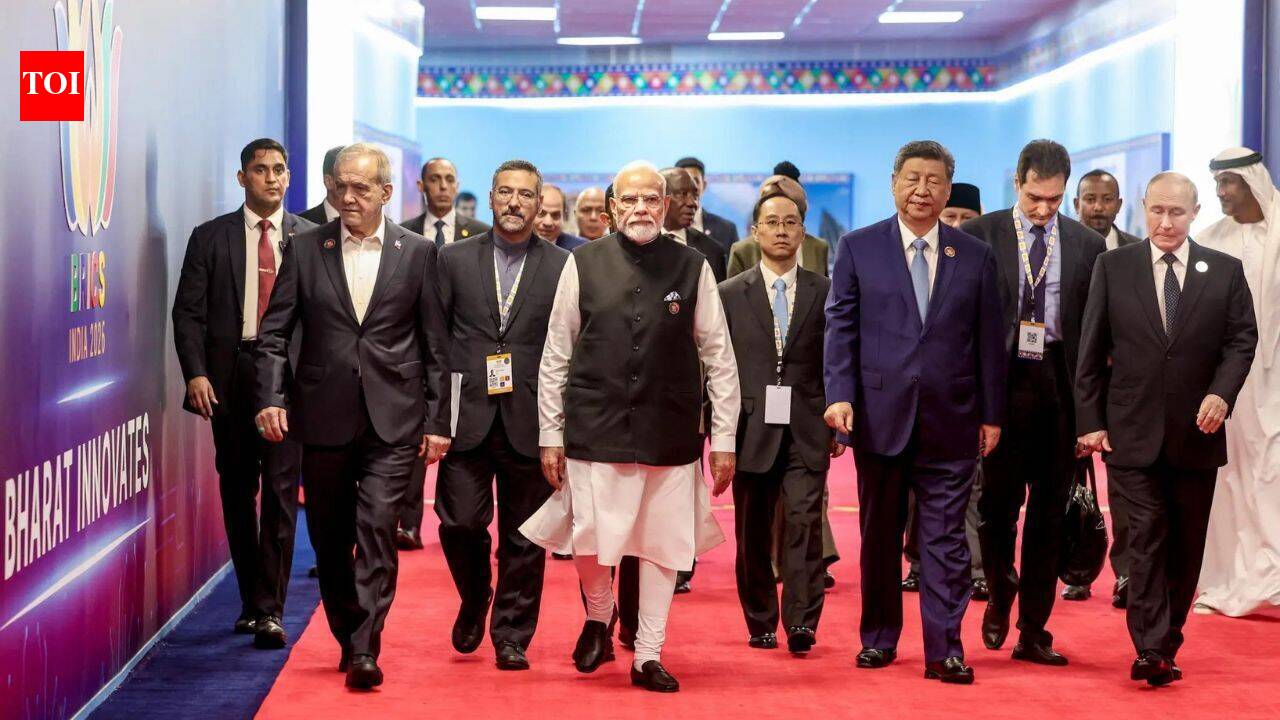
Image credit: Times of India / PTI
Who was in the room, and how much of the world they carry
BRICS now has 11 members: Brazil, China, Egypt, Ethiopia, India, Indonesia, Iran, Russia, Saudi Arabia, South Africa and the UAE. Prime Minister Narendra Modi hosted Russian President Vladimir Putin, Chinese President Xi Jinping and Iranian President Masoud Pezeshkian, alongside South Africa's Cyril Ramaphosa, Indonesia's Prabowo Subianto, Egypt's Abdel Fattah El-Sisi, Ethiopia's Abiy Ahmed Ali, the Abu Dhabi Crown Prince, Malaysian Prime Minister Anwar Ibrahim and Vietnamese Prime Minister Le Minh Hung. UN Secretary-General António Guterres, WTO chief Ngozi Okonjo-Iweala, WHO chief Tedros Adhanom Ghebreyesus and New Development Bank President Dilma Rousseff also attended. Read on NewzAI →
What BRICS represents, by Modi's numbers
The figures the chair used to open the Business Forum. They explain why the bloc's positions travel — and why consensus is hard.
Growth over the bloc's first 20 years:
Two absences and one return stood out. Putin's trip was his first in-person participation at a BRICS summit outside Russia since the war in Ukraine began in February 2022. Xi's was his first visit to India in nearly seven years — his last was Mahabalipuram in 2019, months before the Galwan Valley clashes. Brazilian President Luiz Inácio Lula da Silva stayed home for his election campaign, sending Foreign Minister Mauro Vieira instead. Read on NewzAI →
How India bridged the Iran–UAE chasm
The blockage was specific: Iran and the UAE sit inside the same bloc and on opposite sides of the West Asia war that began on February 28. What broke it was a rare leader-level meeting between Pezeshkian and the Abu Dhabi Crown Prince on the summit sidelines, where both underscored de-escalation and regional stability. Read on NewzAI →
The compromise itself was a piece of drafting. The declaration expresses serious concern over deliberate attacks on civilian infrastructure and on peaceful nuclear facilities under full IAEA safeguards, in violation of international law — implicit criticism of US-Israeli action against Iran, which was what got Tehran to sign. “We in BRICS must fight against the normalization of attacks on civilian, vital infrastructure. The same applies to peaceful nuclear infrastructure,” Pezeshkian said at the summit. No country is named anywhere in that passage. Officials drew the parallel with India's 2023 G20 declaration, which called on states to refrain from the use of force for territorial acquisition without naming Russia.
What the declaration named — and what it pointedly did not
The fastest way to read a consensus document is to check which nouns survived. On terrorism, the text calls for zero tolerance, condemns acts of terrorism as “criminal and unjustifiable, regardless of their motivation, whenever, wherever and by whomsoever committed”, and names the April 22, 2025 Pahalgam attack in which 26 people were killed. It also condemns cross-border movement of terrorists, terrorism financing and safe havens, and pushes for the UN Comprehensive Convention on International Terrorism. Read on NewzAI →
Named, implied, or absent
Where the New Delhi Declaration got specific, where it deliberately blurred, and what never made the page.
On Gaza, BRICS expressed deep concern at continued violence despite the October 2025 ceasefire and called for “halting any policies aimed at forced displacement of Palestinians from Gaza Strip”, reaffirming a two-state solution on the internationally recognised 1967 borders. Ukraine, which appeared in earlier declarations, is absent from this one altogether.
UN reform and the tariff paragraph
The most quoted line was about the Security Council. “China and Russia, as permanent members of the UN Security Council, reiterate their support to the aspirations of Brazil and India to play a greater role in the UN, including its Security Council,” it reads — repeating the Rio formulation of last year. BRICS also called for a more “democratic, representative, effective and efficient” Council, greater representation for developing countries across Africa, Asia and Latin America, and noted the historical absence of a female UN Secretary-General. Read on NewzAI →
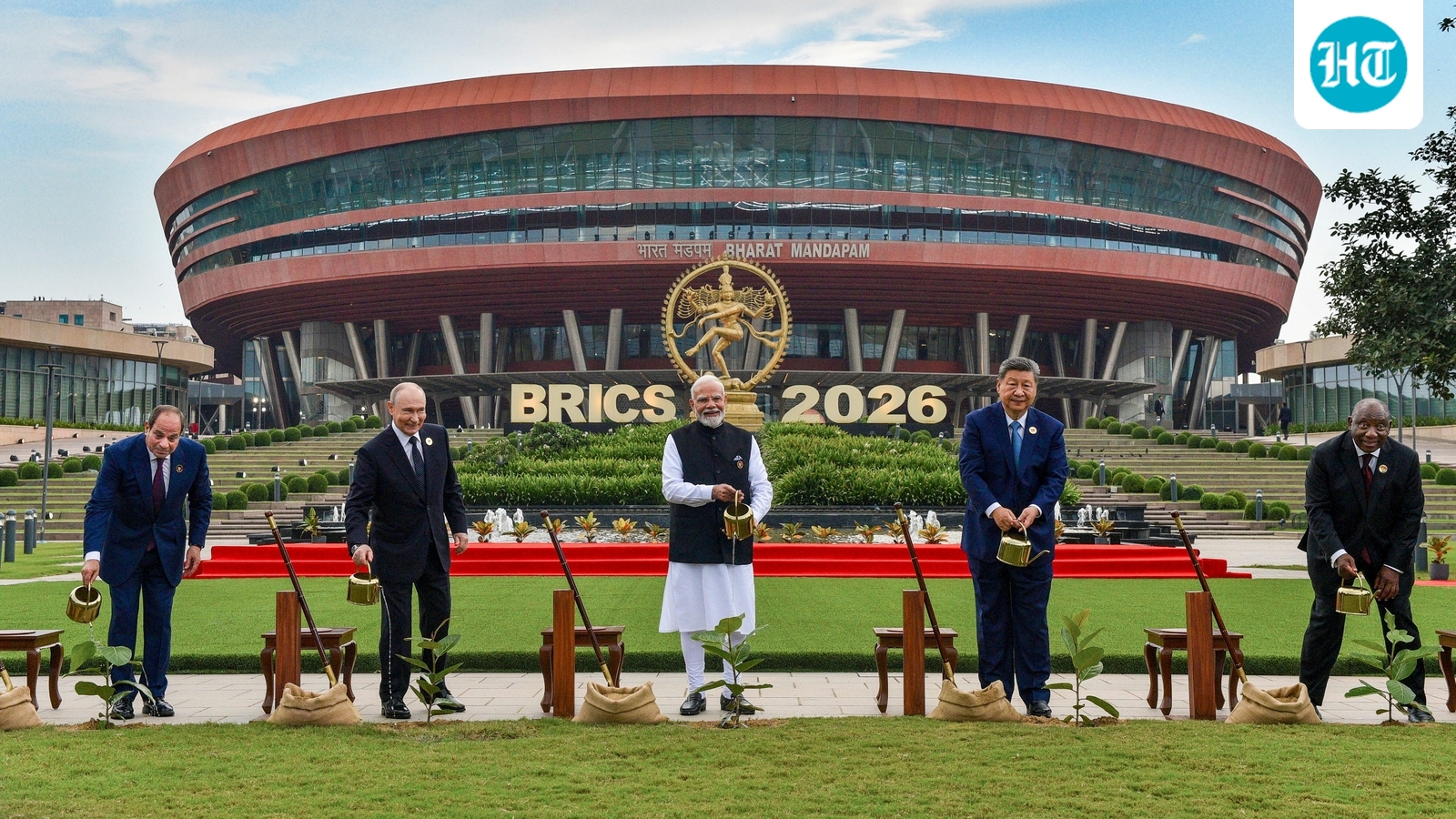
Image credit: Hindustan Times / PTI
On trade, the declaration voices serious concern over the rise of unilateral tariff and non-tariff measures that distort trade, threaten supply chains and create uncertainty. It backs WTO reform, calls for the immediate restoration of a fully functioning two-tier binding WTO dispute settlement mechanism, and condemns unilateral economic and secondary sanctions as contrary to international law and damaging to development, health and food security.
De-dollarisation, without a currency
This was the most misread outcome of the summit, so it is worth being precise. There is no BRICS currency. Asked directly, MEA Secretary (Economic Relations) Sudhakar Dalela said there was no proposal for a common currency “as of now”, and that the focus is on settling bilateral trade in local currencies to cut transaction costs. The declaration makes no direct reference to the US dollar or the United States at all. Read on NewzAI →
What it does contain is plumbing. The text acknowledges the BRICS Payment Task Force and its work on cross-border interoperability of payment and messaging channels, building on the Kazan and Rio declarations, “while respecting national priorities and acknowledging that there is no one-size-fits-all approach”. Leaders also encouraged the New Development Bank to expand local-currency financing — lending in the borrower's own currency so a project in India can be funded and repaid in rupees rather than carrying dollar exchange-rate risk. Read on NewzAI →
The shift is real for members — and marginal for the dollar
Share of Russian export settlements denominated in dollars and euros, as given by Russia's economic development minister at the Business Forum.
The counterweight:
Commerce minister Piyush Goyal urged members to “link our payment systems, trade, in each other's local currencies”; Russia's Maxim Reshetnikov additionally proposed a BRICS grain exchange, arguing members are among the world's leading grain producers and consumers yet still price off benchmarks set elsewhere. Reuters reported before the summit, citing a source, that India was pushing to link central bank digital currencies across the bloc. India's own position remains that replacing the dollar is not part of its BRICS agenda. Read on NewzAI →
The bilaterals that mattered more than the communiqué
Modi and Xi used the sidelines to push a reset. Both sides reaffirmed a strategic, long-term view of the relationship and committed to a “fair, reasonable, and mutually acceptable” resolution of the boundary question. Modi stressed that peace and tranquility in the border areas remains an essential basis for the relationship, that differences should not become disputes, and that both sides be guided by three mutuals — mutual respect, mutual sensitivity and mutual interest. Read on NewzAI →
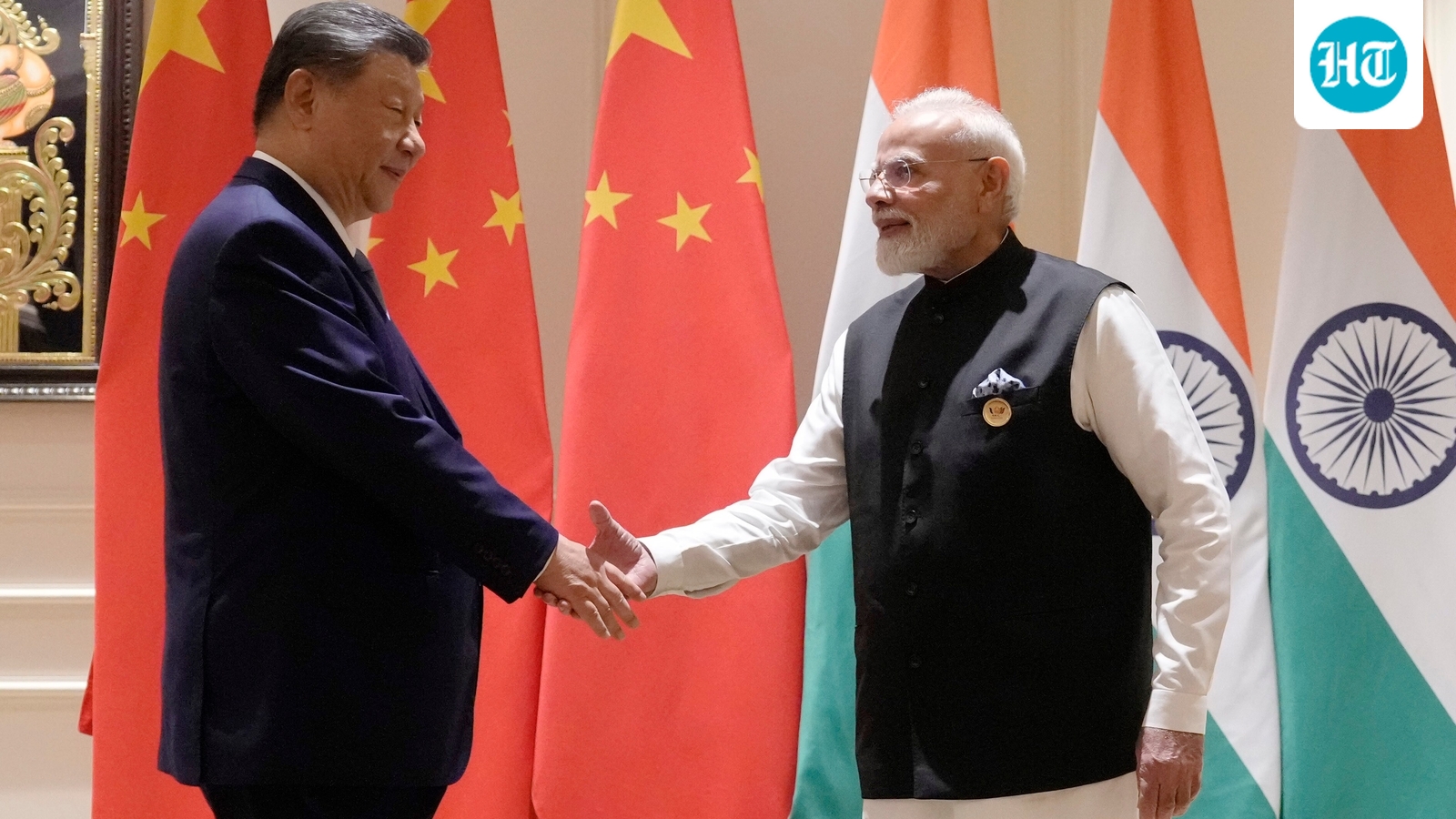
Image credit: Hindustan Times
With Putin, the meeting ran over 45 minutes and produced a target of $100 billion in bilateral trade by 2030, plus talks on defence, energy, critical minerals, civil nuclear cooperation and fertilisers. Modi raised the safety of Indian seafarers — five have died in the Black Sea amid the Russia-Ukraine hostilities. Putin invited Modi to Russia for the 24th India-Russia Annual Summit, dates to be set through diplomatic channels. The two then travelled in the same car inside Bharat Mandapam, and Modi presented Putin a Russian translation of the Thirukkural.
The quieter agenda: AI rules, sea cables and early warning
Under the geopolitics sat a long technology chapter. Leaders committed to implementing the BRICS Leaders' Statement on the Global Governance of Artificial Intelligence, calling for wider access to AI resources alongside safety, security and reliability safeguards, and flagging risks from cybercrime, disinformation and deepfakes. The text also addresses AI and intellectual property directly, recognising the need to respect IP rights in AI training and “fair remuneration” for rights holders, and warning of misappropriation of knowledge and cultural values under-represented in training data. Read on NewzAI →
Members backed a “sovereign and self-reliant digital ecosystem”, noted a proposed BRICS digital public infrastructure repository, and carried forward a feasibility study for a high-speed submarine cable network linking member countries. On health, they welcomed a dedicated sub-working group to advance a BRICS Integrated Early Warning System for mass infectious diseases, plus a common GxP white paper for medical product regulators and NIMHANS Bengaluru as the coordinating centre for a mental health training hub. Read on NewzAI →
India's footprint: 350 meetings and a banyan tree
India's chairship theme was “Building for Resilience, Innovation, Cooperation and Sustainability”, framed as a people-centric, humanity-first approach. “More than 350 meetings were organised, and we had the opportunity to welcome your teams in nearly 30 cities,” Modi said at the opening. Read on NewzAI →
Several Indian proposals landed in the text: a BRICS Risk Lab at GIFT City in Gujarat, the India Centre for BRICS Industrial Competencies, the Jaipur Consensus on an invoice discounting mechanism for export-oriented MSMEs following the inaugural BRICS SME Forum in Agra, and acknowledgement of the Coalition for Disaster Resilient Infrastructure and the International Big Cats Alliance. Leaders also planted a banyan tree as a symbol of continuity and interconnectedness. Read on NewzAI →

Image credit: News18
At the Business Forum, Putin was blunter about the West: “We have always been told that competition is a sacred cow, something that must not be touched. Yet, unfortunately, today your Western competitors are trying by any means necessary to regain their former leadership.” Pezeshkian pushed for capacity to become practice: BRICS' strength “becomes more apparent when these capacities are transformed into a network of trade, investment and joint financing”.
The bigger picture: cohesion, or just a bigger table?
Foreign coverage split on whether size means strength. China's Global Times argued a “more united, efficient, pragmatic” greater BRICS would “open up new space for the common development of the Global South”. The South China Morning Post, Reuters and the Washington Post focused on internal divisions, particularly Iran and the UAE. Michael Kugelman of the Atlantic Council told the BBC that “India cannot afford to have a joint statement that rails against Washington”, expecting criticism of US policy to be vague and indirect — which is close to what the final text delivered. Yun Sun of the Stimson Center told the New York Times that Beijing's primary concern with India has always been its alignment with the United States. Read on NewzAI →
What to watch
Three things will show whether New Delhi's consensus holds. First, whether the Payment Task Force and the CBDC-linking work produce an operational pilot rather than another working group — and whether the NDB actually shifts its loan book into local currencies. Second, whether the Modi-Xi boundary language survives contact with the Line of Actual Control, and whether the 24th India-Russia Annual Summit gets dates. Third, whether the carefully unnamed language on attacks against civilian and nuclear infrastructure holds if West Asia escalates again — the declaration landed days before Iran's talks with GCC countries on the Strait of Hormuz.
Follow This Story on NewzAI
NewzAI tracks breaking news in real time — summarised from multiple sources so you get the full picture, not just a headline.
BRICS hammers out joint declaration after India bridges Iran-UAE chasm →
New Delhi Declaration unveiled: Pahalgam, UNSC expansion and India-led digital infra →
No common currency, but BRICS gives de-dollarisation a push through the NDB →
Iconic moments, landmark talks & a breakthrough pact: Key points from BRICS Summit →